
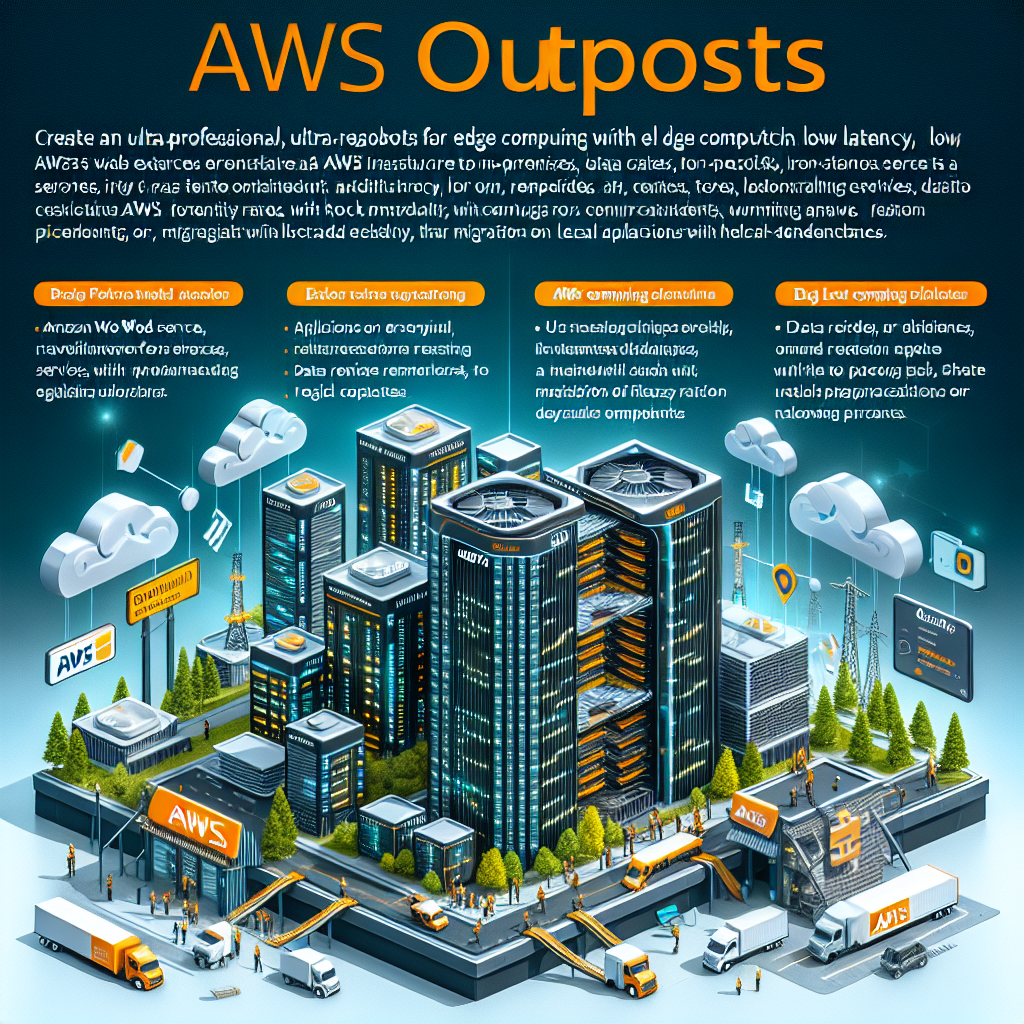
In today's landscape, where speed and efficiency are crucial to business success in industries such as finance, healthcare and manufacturing, finding solutions that deliver ultra-low latency is more relevant than ever. AWS Outposts is a powerful answer to that demand, with hybrid infrastructure that combines the best of the cloud with on-premises capabilities. In this article, we'll look at how AWS Outposts, a fully managed Amazon Web Services (AWS) solution, extends AWS infrastructure, services, APIs and tools to on-premises data centers and edge sites.
If your goal is to optimize applications that require fast data processing, meet regulatory requirements or make it easier to migrate legacy applications, read on to discover how this technology can transform your organization's performance.
What is AWS Outposts?
AWS Outposts is a fully managed Amazon Web Services (AWS) solution that lets organizations run hybrid workloads consistently. It extends AWS infrastructure so you can run native AWS services on premises, connected to the rest of the services available in your chosen AWS Region. This approach is ideal for applications that need low latency, local data processing and data residency, and it's especially effective in industries that handle sensitive information or require high processing speed, such as high-frequency trading and real-time machine learning inference.
Why choose AWS Outposts?
The advantages of AWS Outposts are broad and extend across many applications and industries. Let's look at some of the main reasons to consider this solution:
- Low latency: because data is processed locally, applications respond faster, which is essential for industries like finance and telecommunications.
- Flexible deployment: Outposts comes in different form factors, including full racks (42U) for large data centers and compact servers (1U or 2U) for smaller environments such as retail stores and clinics.
- Simplified management: AWS manages both the hardware and the software, reducing the operational burden on IT teams so they can focus on innovation and improvements.
- Compliance: the ability to keep data on premises helps organizations meet regulatory requirements, especially in regulated industries.
How does AWS Outposts work?
AWS Outposts is designed to integrate seamlessly with existing AWS services and deliver a unified cloud experience. The solution lets you process data locally without losing your connection to AWS services in the cloud. That brings a series of benefits:
- Interoperability: services can interact with each other, making data and application management easier.
- Scalability: as processing demand grows, organizations can easily scale their operations by adding more Outposts as needed.
- Automatic updates: AWS updates the software automatically, so services are always secure and up to date.
Benefits of AWS Outposts for edge computing
AWS Outposts is a smart choice for companies that rely on edge computing, since it meets several critical needs:
| Benefit | Description |
|---|---|
| Ultra-low latency | Processing data locally reduces application response times. |
| Higher throughput | The capacity to process large volumes of data quickly. |
| Centralized management | Simple management through the AWS interface, on premises and in the cloud. |
| Stronger security | AWS implements robust security measures to protect data and applications. |
Case studies: how companies use AWS Outposts
Many companies are already taking advantage of AWS Outposts to optimize their operations. One notable example is a global investment bank that deployed the solution for its high-frequency trading operations. With the ability to process transactions in milliseconds, the institution significantly increased its competitiveness, with lower latency and higher throughput in its operations.
Another case is a telecommunications company that adopted AWS Outposts to expand its 5G infrastructure. The solution let it process data locally in remote areas, improving service quality and the end-user experience.
Trends and what's next for edge computing
The future of edge computing is promising, especially with the growing adoption of technologies like 5G and IoT. That should increase demand for solutions that deliver low latency and efficient local data processing. AWS Outposts is positioned as a cornerstone of this landscape, with infrastructure that not only meets today's needs but also adapts to future demands.
Advances in AI and machine learning are also creating a growing need to process large volumes of data in real time, which AWS Outposts is perfectly suited for. With the ability to run machine learning inference locally, organizations will be able to make faster, better-informed decisions.
Checklist for implementing AWS Outposts
When considering an AWS Outposts deployment, it's important to follow a checklist that covers every stage:
- Identify your latency and processing capacity requirements.
- Consider the Outpost's physical location.
- Check compatibility with existing applications.
- Plan the integration with AWS services in the cloud.
- Train the IT team to manage the infrastructure.
Frequently asked questions
1. Is AWS Outposts a good fit for small businesses?
Yes. AWS Outposts offers compact form factors that can fit small environments.
2. How does AWS Outposts keep data secure?
AWS implements robust security measures, such as encryption and constant monitoring.
3. Do I need advanced technical skills to use AWS Outposts?
Some technical knowledge helps, but AWS offers resources and support that make deployment and management easier.
4. Is Outposts compatible with every AWS service?
Outposts supports a wide range of native AWS services, enabling easy, efficient integration.
5. How does AWS Outposts compare with other edge computing solutions?
AWS Outposts stands out for its flexibility, simplified management and ability to operate in a hybrid environment.
6. Which industries benefit most from AWS Outposts?
Industries such as finance, healthcare, manufacturing and telecommunications benefit most, because of their need for low latency and high reliability.
7. Is there specific support for migrating legacy applications?
Yes. AWS Outposts is ideal for migrating legacy applications with on-premises dependencies, making the transition easier.
Conclusion
AWS Outposts isn't just a technical solution but a strategic opportunity for companies that want to stand out in an increasingly competitive market. Thanks to its ability to deliver low latency and enable local data processing, Outposts is an ideal solution for edge computing workloads. By bringing AWS services into a hybrid architecture, organizations can optimize their operations, improve compliance and drive innovation.
We invite you to learn more about AWS Outposts and consider how this technology can fit your needs. The future of edge computing has already begun, and being at the forefront of this transformation could be the key to your success.