Case study
STP Systems
Containerized microservices with independent deployments for a business management SaaS.
About the client
Online management platform
Founded in Rio de Janeiro, STP Systems builds management systems for micro, small and midsize businesses. Its team brings together developers with experience in Brazil and the United States and finance and management professionals who have implemented major global ERP systems.
The company strikes a balance between innovation and robustness, with agile development methods and rigorous testing inspired by the validation of mission-critical systems, and with a focus on regulatory compliance and extensibility.
STP's ERP delivers gains in productivity and control by reducing routine tasks and unnecessary spending, with an approach that combines simplicity, efficiency and high availability. STP is a software as a service (SaaS) provider in the management space.
The challenge
Reduce costs and make market expansion viable
To support its development team, STP needed infrastructure built on the best technologies for a microservices architecture, with agility, flexible scalability, simple deployment and resilience.
The team also needed a highly scalable, high-performance container management service, based on the Twelve-Factor App methodology.
The solution
Exclusivity, innovation and security
The solutions architects at KXC, an AWS partner, and the STP team jointly built a microservices-based CI/CD infrastructure that lets the company build, test and deploy applications quickly and securely.
This infrastructure enables decentralized, independent deployments of multiple software packages, in standardized units called containers. The solution uses DevOps to automate process integration, simplify the application lifecycle and abstract away the environment's architecture. AWS services such as AWS Fargate, Amazon ECS and Amazon EKS make it easier to run and manage Docker containers at scale.
For the microservices environment, the partnership implemented these AWS services:
- AWS CodePipeline: a managed continuous delivery service that automates release pipelines for fast, reliable application and infrastructure updates.
- AWS CodeBuild: a fully managed continuous integration service that compiles code, runs tests and produces ready-to-deploy packages.
- AWS Fargate: a serverless container engine that works with Amazon ECS and Amazon EKS. It removes the need to provision and manage servers, charges for the resources each application uses and improves container security.
- Amazon ElastiCache: improves performance by retrieving information from in-memory caches instead of relying on slower disk-based database queries.
- Application Load Balancer: distributes HTTP and HTTPS traffic at the application layer (layer 7), with advanced routing for microservices and containers.
- Amazon RDS: synchronously replicates data to a standby instance in another Availability Zone, and also provides automated backups and snapshots.
- Amazon Route 53: a scalable cloud DNS service, used for health checks and service discovery between microservices.
- Amazon CloudFront: a content delivery network (CDN) that delivers data, videos, applications and APIs securely, with low latency and high speed.
- Amazon GuardDuty: identifies threats by continuously monitoring network activity and account behavior on AWS.
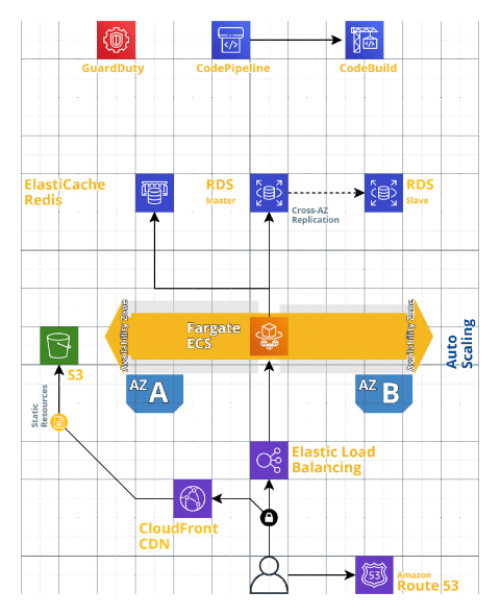
AWS services used
Results
A highly available, secure and scalable environment
With a well-designed architecture and AWS infrastructure, KXC met the goals agreed with STP.
STP now runs its application with high availability and scalability, ships updates with zero downtime and has more time to focus on its customers.
More case studies
Book a call with one of our specialists
Fill in your details and the service you need. We'll get in touch to find a time that works for you.